
Fuel Tank: converting liters to US gallons without the usual mess
Last Tuesday I watched somebody ruin a fuel tank job by trusting a rounded conversion they half-remembered from a phone screenshot.
We write these the way we argue them on the bench: exact factor, one sharp trap, one worked example you can re-check.
Last Tuesday I watched somebody ruin a fuel tank job by trusting a rounded conversion they half-remembered from a phone screenshot. Start from 1 L = 0.26417205236 US gal, keep units glued to every intermediate number, and only round when the tool or spec actually forces you to.
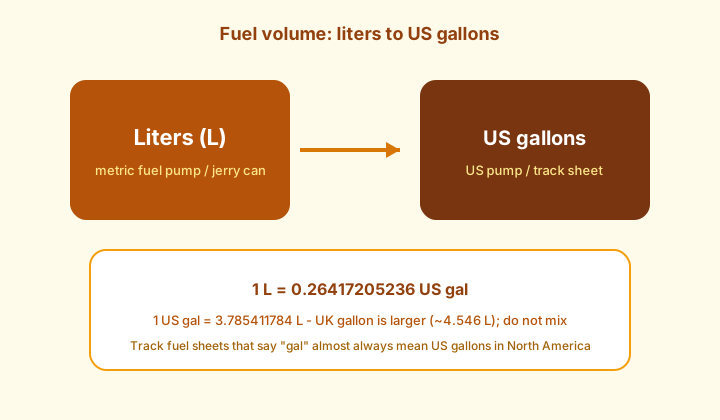
The factor that settles arguments
This is the relationship our converters use. Screenshot it if you have to — just stop re-deriving it from a half-remembered blog post.
1 L = 0.26417205236 US gal
Write that line once at the top of your notes. Every later arithmetic step should point back to it instead of inventing a friendlier number mid-stream.
The mistake that keeps showing up
Grabbing a “close enough” liters→US gallons shortcut and applying it to fuel tank before you check whether you are on a US, imperial, or metric definition.
If a website and your calculator disagree by more than a rounding crumb, check whether somebody used a US, imperial, survey, or nutrition-label definition.
If you only need a ballpark for automotive, say so out loud. The trouble starts when a ballpark quietly becomes the purchase order.
- Write the known value with the unit: ___ liters.
- Confirm you want US gallons (not a lookalike unit).
- Multiply by the exact factor: 1 L = 0.26417205236 US gal.
- Round only at the end to the tool/spec precision.
Worked example
Say you are setting up fuel tank and the plan calls for 2 liters.
2 liters × 0.264172 = 0.528344 US gallons
That is 0.528344 US gallons. Use it as written, then round only to the scale, ladle, gauge, or print tolerance you actually have.
If you want a second check, invert the conversion and see whether you recover the original quantity within normal rounding. When you do not, you flipped the factor or mixed two definitions of the same named unit.
Quick reference table
| liters | Calculation | US gallons |
|---|---|---|
| 1 | 1 × 0.264172 | 0.264172 |
| 2 | 2 × 0.264172 | 0.528344 |
| 5 | 5 × 0.264172 | 1.32086 |
| 10 | 10 × 0.264172 | 2.64172 |
Use the table for speed once you trust the factor. Do not use it as a substitute for understanding which definition of the unit you are on.
Why the exact number matters
Fuel Tank is unforgiving about silent unit swaps. One clean conversion keeps the shopping list, the machine setting, and the final check talking about the same physical quantity.
Precision is not about showing off decimals. It is about making sure the shopping list, the machine setting, and the acceptance check are all describing the same physical quantity.
Pocket recap
Write 1 L = 0.26417205236 US gal once. Multiply liters → US gallons in one step. For fuel tank, the last digit only matters when the real-world tolerance says it does.
Keep the converter link nearby for the next time the same debate shows up in a group chat. Re-typing the factor from memory is how the wrong cousin of a unit sneaks back in.
Try the converters mentioned in this article
FAQ
What is the exact liters to US gallons factor?+
1 L = 0.26417205236 US gal
Can I round early for fuel tank?+
Carry full precision through the multiply, then round the final value to match the measuring tool — early rounding is how small errors become visible defects.
How do I sanity-check the direction?+
Estimate first. If the answer moves the wrong way by an order of magnitude, you flipped liters and US gallons.
This article was written by The Turbo Unit Converter engineering desk (Applied units & field metrology) and last reviewed on 2026-07-21 against NIST SP 811 and the BIPM SI Brochure. Read our full editorial policy.