
Your CGM says 6.2 but the clinic printout says 112 — both can be right
My father-in-law's Dexcom showed 6.1 mmol/L at dinner. His US clinic report from the same week listed 110 mg/dL fasting. Same person, same condition, two unit systems on two pieces of paper.
We translate lab units for family abroad — not for diagnosis, just so the same number does not look like a crisis.
This is not a math puzzle for trivia night. People with diabetes travel, share records with relatives in Europe, and compare CGM trends to old fingerstick logs. When one screen says mmol/L and another says mg/dL, stress comes from not recognizing the same glucose concentration dressed in different clothes.
Important boundary: this article explains unit conversion only. It is not medical advice. Treatment targets are set with your clinician. Numbers here are for translation, not diagnosis.
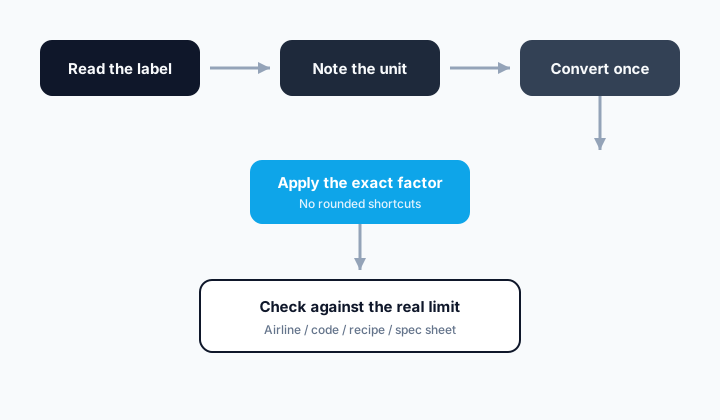
The exact glucose conversion
mmol/L × 18.0182 = mg/dL > mg/dL ÷ 18.0182 = mmol/L > (Many clinics round to 18.0 for mental math — know which your lab uses on printed reports.)
The factor comes from glucose molar mass (about 180.16 g/mol) and the decilitre volume. Cholesterol uses a different factor. Triglycerides another. Do not reuse 'divide by 18' for every lab value on the page.
Reference ranges in both units — for orientation only
| Context | mg/dL | mmol/L |
|---|---|---|
| Normal (ADA) | 70–99 | 3.9–5.5 |
| Prediabetes | 100–125 | 5.6–6.9 |
| Diabetes threshold | ≥126 | ≥7.0 |
Ranges differ slightly by guideline (WHO vs ADA) and whether the sample was fasting. Use the range printed on your lab report first.
Worked example — CGM 6.2 mmol/L to mg/dL
Dexcom afternoon reading: 6.2 mmol/L. Father wants to compare to his old US log in mg/dL.
6.2 × 18.0182 = 111.7 mg/dL → rounds to 112 mg/dL on most displays
A fingerstick at the same minute might read 108 or 115 mg/dL. CGM measures interstitial fluid with a lag; fingerstick is capillary blood. Close conversion does not mean identical simultaneous measurement.
Why CGM and fingerstick disagree even after conversion
- **Timing lag:** CGM can trail blood by 5–15 minutes during rapid changes. - **Calibration:** Fingersticks calibrated to lab plasma may differ from factory CGM calibration. - **Rounding:** App shows one decimal in mmol/L; meter shows whole mg/dL. - **Compression lows:** Sleeping on a sensor can produce false lows unrelated to unit math.
Convert first, then discuss trend shape — not single-point arguments across devices.
HbA1c is a third unit system
US often reports HbA1c as % (NGSP). IFCC uses mmol/mol. Example: 6.5% ≈ 48 mmol/mol. That conversion is unrelated to the mmol/L ↔ mg/dL glucose factor. Mixing these on a spreadsheet is a common family-health group chat mistake.
Pocket recap
Glucose only: mmol/L × 18.0182 = mg/dL. Convert before you compare CGM to US lab paper. Expect small differences between devices even when units are correct.
Try the converters mentioned in this article
FAQ
Can I use 18 instead of 18.0182?+
For quick mental math, 18 is close (6.0 mmol/L → 108 vs 108.1 mg/dL). For logging alongside lab results, use the full factor or the converter so cumulative error does not matter on tight targets.
Why does my UK app default to mmol/L?+
Most countries use SI-derived mmol/L for blood glucose. The US retained mg/dL historically. Device region settings often follow market, not medical preference.
Does this apply to urine glucose strips?+
Urine strips measure qualitatively or in different concentration units depending on the product. Do not assume the same mmol/L ↔ mg/dL factor without reading the strip documentation.
Is 250 mg/dL the same as 13.9 mmol/L?+
250 ÷ 18.0182 ≈ 13.9 mmol/L. Yes for glucose unit conversion. Whether that value is expected for you is a clinical question.
This article was written by The Turbo Unit Converter engineering desk (Clinical unit literacy) and last reviewed on 2026-07-28 against NIST SP 811 and the BIPM SI Brochure. Read our full editorial policy.